

orlo.leini@gmail.com

MAGIC SHOW
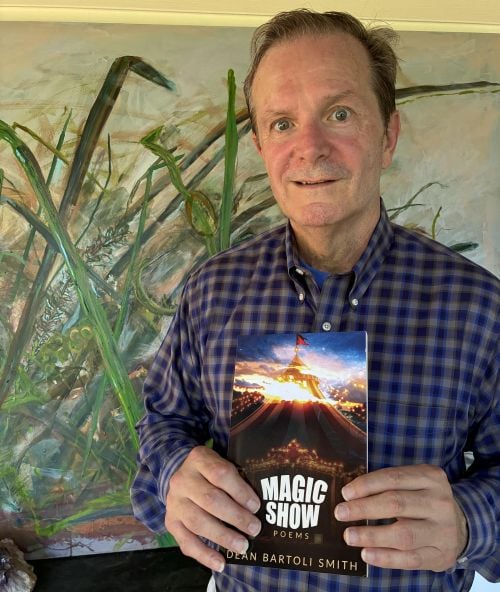
Poems by Dean Bartoli Smith
Reviewed by Ricky Ruszin
Life, Dean Bartoli Smith, presents in the pages of his new collection, can be like a magic show—albeit one we never anticipated or purchased a ticket for. Sometimes we’re in the audience, full of childlike wonder as we witness something awe-inspiring, and sometimes we’re astonished to discover we’re the main act. Sometimes it’s hard to tell the difference.
Like a theater of sleigh-of-hand, this collection of forty-seven poems is filled with illusions, special guests, surprises, and acts that go very wrong, very quickly—filled with “failed pyrotechnics,” “chains locked tight,” and “mouth[s] singed with ash.”
But instead of a vanishing rabbit, the things that go poof! are intangible—family and love, ambition and hope. These glimpses into harrowing experiences aren’t melancholy merely because of their content, but because the narrators don’t know they’re in the center ring of a life-defining spectacle until it’s already in play.
In the hands of a lesser writer, the themes presented in Magic Show would be obscured by abstract language and flat, stale diction, but it’s a testament to Bartoli Smith’s attention to craft and careful curation of imagery that the collection’s motifs are both unified and accessible to casual readers as well as poetry aficionados.
Magic Show is broken into three sections, each expounding on hefty themes buoyed and brightened by fresh language and crisp, evocative imagery. “Folly Beach” features a “Rocket-Pop sky / melting into night,” evoking the popsicle-filled, sticky-sweet summers of childhood, while “Pollock’s End” boasts “jagged red lassos on / a creased metallic canvas” to detail a bloody corpse—a nature artist quite literally becoming art in nature, his blood dripping from a tree following a car accident.
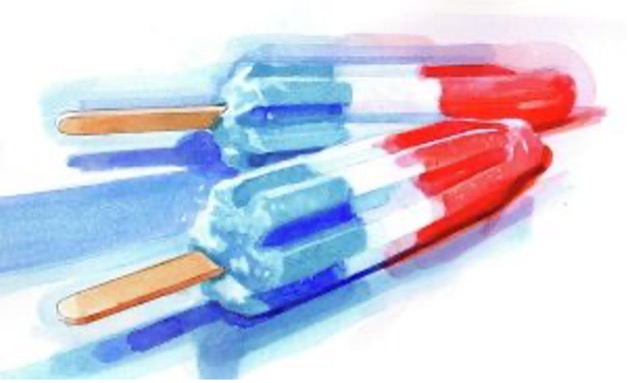
Whether focusing on flashes of cheery nostalgia or grim tableaux, the imagery is a pleasure on the eyes and ears, beckoning the reader to savor each morsel like a carefully wrapped gift.
In this way, the theme of Part I presents itself: lives ending in failure, and the collapse of the natural world. It’s especially heightened in “Welcome to Dreamland” where the world’s picturesque beauty is turned horrific, scarred by a “conveyor-belt of broken homes” and “human demons.” Is decay sudden, or has it always been there, grinding until we’re powerless to stop it? The answer doesn’t seem to matter as much as the feelings the question instigates—pain, sadness, isolation.
Part II transitions from desolation to love and loss and the unexpected way both can arrive. “Giving” presents the image of a dying tree—and a dying marriage—by illustrating how both met their end “in a slow breaking down / of arms ripped from sinews.”
Meanwhile, “I Saw You, Classifieds” utilizes the scene of a car accident to show how quickly normalcy can turn to horror, packed with visceral sensory details of a “face crack[ing] the road” and a victim who “staggered blindly to the curb.”
A particular highlight, “Bay Rum Blues” deftly blindsides the narrator—and reader—by showing how love, passion, and desire are brought to a halt by a grim, heartbreaking association a woman has to her husband’s cologne.
Growth, however, often proceeds both hardship and comfort, and this dichotomy is prevalent in Part III, which revolves around childhood through the lens of adulthood. Whether focusing on the idea that it’s the smallest things we remember most deeply, like the narrator remembering “waiting for the late train” at the zoo in “Captain America,” or the young girl in “Stars” who watches the “stars dancing” and insists that “unicorns are real,” these poems are imbued with the pure magic of childhood belief—something to be cherished and wrapped in a protective shroud, nurtured instead of dissuaded by adults. They evoke the hopeful feeling that, although magic may not be real, holding onto the idea of it is crucial.
The adult narrators in these pages are also aware that childhood is filled with confusion, disappointments, and even violence. Through unflinching descriptions and well-crafted personification, kids are forced to grow up as they attempt to protect each other from horrors they should never have to face—from parents, to peers, to racism in a “postwar suburban paradise.”
A particularly heart-wrenching poem, “Storms” details the unpredictable (and explosive) violence of adults through a “father’s / thunder in the trees” and how kids seek solace by playing games and communicating with “Dixie Cups / and string.”
Life’s horrors are inevitable and unpredictable. But, like a magic show, they don’t last forever. The dark velour curtain closes eventually—the showmen move on to the next act, the next theater, the next city. But until they do, how can they be faced? The answer is buried in the pages of Magic Show: Art.
“Welcome to Dreamland” begs the reader to “unchain humanity with beautiful magic: songs and poetry” while “Let it Bleed” illustrates how discovering the perfect song at the perfect time ensures that “life / would never be / the same again.”
The written word is what enables us to experience salvation, to fall in love, and, in the case of “I Saw You, Classified,” where the narrator approaches the victim of a car crash and “dabbed excess blood with ripped out pages” of a book, to literally heal. Art as a life-saving measure isn’t a new theme, but Bartoli Smith’s creativity and sense of play with language and subject matter ensures it’s dealt with in innovative ways.
The collection succeeds on both a narrative and technical level; however, the abstraction in “Encounters” and “Gauze”—and the stream of consciousness employed in “Wild Things Revisited” and “Blue Horseshoes”—makes the reader work too hard to identify, with clarity and certainty, the poems’ subjects and themes.
Similarly, the line breaks in “Giver” and “Death of a Salesman” make for an assembly that isn’t quite as pleasing as hoped, leading the reader to pause and re-visit sections instead of disappearing in the diction. Also causing pause is the occasional use of Italian, though it succeeds in conjuring a specific time and place.
Magic Show highlights the world’s dark, unexpected illusions: a wife ripped away from a husband; a child forced to grow up too quickly. But despite the viscous poison stealthily dripping through the cracks of our carefully crafted veneers, art is a kind of magic. It is, and always will be, the antidote.
Bartoli Smith astutely reminds us that, rather than dwelling on past failures and hardships, we always have the choice to see “hope in the ruins.”
Magic Show was released in October 2026 by Codhill Press of New Paltz, New York
Ricky Ruszin is a writer living in Dundalk, just over the Baltimore City line. He can be reached via rruszin17@aol.com
Joe’s Travel Pizza
On January 7, 2024, Joseph Harrison’s ad hoc Shakespeare class met for the last time. After several years on Zoom, Harrison and his group of his Shakespeare-loving friends met in person at his home in Overlea for Joe’s presentation on *The Tempest* and some pizza. Though I didn’t know it at the time, this was the last I would see him: On 13 February he died peacefully in the same house.
We had studied the great plays with Harrison for years. He never charged anything — just offered his brilliant, bold, irreverent scholarship for free, wanting nothing more than our company and ideas. We loved listening to him, his voice a distinctive, rolling, musical cadence shaped by a boyhood in Virginia and Alabama.
That instrument also conveyed his own magnificent, technically dazzling, hilarious and deeply moving poems, which he had read and recited in venues ranging from scruffy Waverly cafes to the Folger Library in Washington, D.C. and the Hammer Museum in Los Angeles. Those poems brought him from a spartan rented room in Waverly with a hole in the roof to some of the most distinguished literary kudos a poet can earn
Now, brain cancer and its treatment had muted Joe’s beautiful voice. His recitation of Prospero’s epilogue left us speechless, sighing with emotion. But the incipient grief was eased by the addition of good food — in this case, furnished by Armando Buontempo.
Among Joe’s greatest loves, along with poetry, politics, baseball, football and history, was fine food. He was a terrific cook and devoted gourmet. When the large, inoperable brain tumor was discovered in the fall of 2023, Joe used his remaining energy to write, teach, socialize, and dine on his favorite chef’s creations. Smoking heroic amounts of pot preserved his mood and appetite, despite the grim prognosis and the tortuous chemotherapy. His friends and family drove around town to bring him a shimmering progression of last meals, from the sushi at the lauded Minato in Mount Vernon to the succulent Argentinian-style beef at Roberto Cardona’s La Barrita Restobar.
Harrison relentlessly searched out — and found — amazing food everywhere. One of his favorite spots was right around the corner from his house: Frank’s Pizza and Pasta on Belair Road. Armando Buontempo and his cousin Frank emigrated to the U.S. in 1983 from Monte di Procida where Armando and his six siblings grew up, a small seaside village in Campania, west of Naples. Together Frank and Armando opened the small strip-center restaurant, which makes authentic Italian chow that Joe swore by.
Joe loved Armando and brought him a lot of business. Armando loved him back, and called him Joe the Poet. Joe and I would meet Joe at Frank’s on Wednesdays to take advantage of the spaghetti and meatballs for two special — less than $20 for two nice servings of pasta with delicious sauce and big, juicy meatballs, two nice little salads and fresh baked breadsticks with garlic butter.
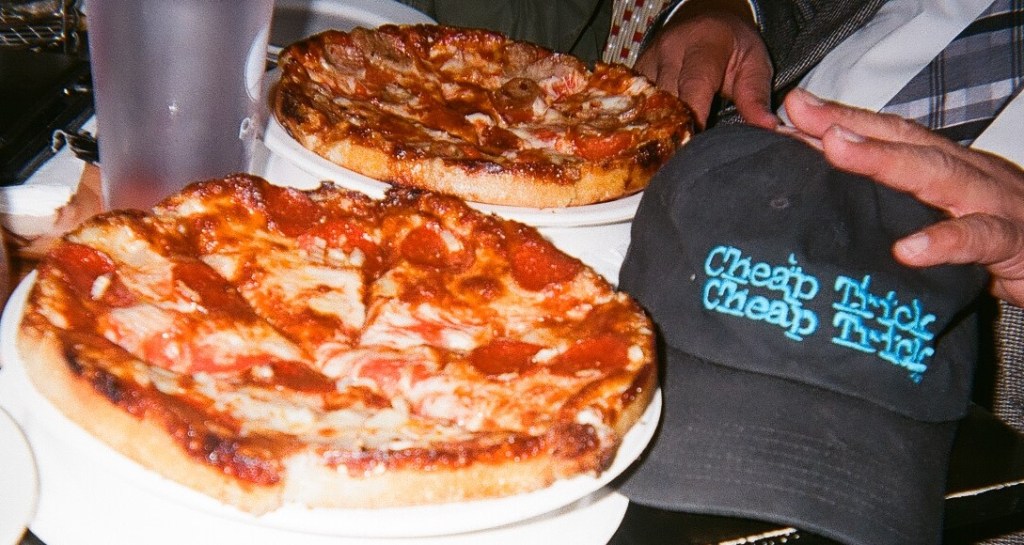
For the last Shakespeare class, Armando made one of his specialties: pizza rustica, or, as it was known in Armando’s family, “travel pizza.” The boxes arrived and inside were massive pies, double crusted, stuffed with white cheeses, broccoli, cauliflower and boiled eggs, ham, and more. One slice would make an entire meal.
The recipe for the pie came from Armando’s mother in Monte di Procida. It was adapted from her contribution to the village Easter feast, where on Easter Sunday Armando and his family and neighbors would happily gorge on rich delights forbidden them for the forty days and nights of Lent, including sweets, bacon and ham. The boiled eggs, Armando says, were symbols of eternal life.
“All the women of the village would prepare their specialties for the big feast,’ Armando says. “There was quite a bit of competition. My mother made 20 different cakes. Though she was never confident about her cooking, my mom’s recipes were great, and we loved them.
“When we were young, she would wrap up slices of the stuffed pie for us to take on our Easter Monday picnic, and she did the same after we came to the U.S. and returned home to visit her each year. We always had slices of ‘travel pizza’ wrapped in foil for my journey — none of us had to settle for the food in the airport or on the plane,” he says.
True confession: I’m a non-foodie. I hate to cook, and mostly eat to live. But when my mother died in 2012, Joe Harrison invited my husband and me to join him for a week at the apartment where he was staying in Rome. There, we ate hot *suppli,* fried squash blossoms secreting anchovy fillets, scarlet melon as sweet as first love, milk-dripping buffalo mozzarella on still-warm bread, grilled fish that tasted of clear blue, skylit sea water and my very favorite, a small, earthenware bowl of the simple classic cacio e pepe, which might be the most delicious thing I’ve ever tasted. It was as if you could taste joy, hope, continuity of family and pure love in every bite.
“There is a story behind every dish,” Armando says.
There was plenty of pizza left after the class. We thanked Joe, kissed him, gathered our things. He needed to rest; the two-hour gathering had exhausted him.
I quietly did some dishes and drove home, two giant slabs of Armando’s tribute wrapped in foil and riding in a bag on the passenger seat. At a stoplight, I rested my hand on them, comforted by their warmth.


